"Every child is born a scientist. The trick is to nurture that curiosity."
At Good Shepherd Episcopal School, we believe that wonder and discovery are at the heart of learning. Our STEM program cultivates the natural curiosity that lives within every child through hands-on exploration, collaborative problem-solving, and real-world applications.
From our youngest learners observing butterflies in the garden to our fifth graders designing solutions to everyday problems, STEM education at Good Shepherd is woven into the fabric of our academic experience. We create an environment where questions are celebrated, mistakes become learning opportunities, and every discovery is a step toward understanding our amazing world.
Our STEM Curriculum by Grade Level
Foundation Builders: Early Learning (Ages 3-4)
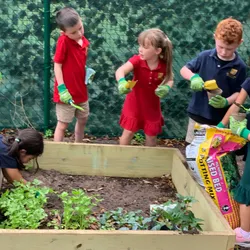
Early learners discover patterns and relationships through hands-on exploration in our outdoor classroom.
Our youngest scientists begin their journey through sensory exploration and wonder-based learning. Students develop observation skills through nature walks, practice early math concepts with hands-on sorting activities, and conduct simple experiments that spark curiosity about the world around them.
- Nature scavenger hunts
- color mixing experiments
- building with blocks
- measuring with non-standard units
Pre-K (Age 5): Young Investigators
Pre-K students use magnifying glasses to examine plant structures, developing observation and documentation skills.
Pre-kindergarten students dive deeper into scientific thinking through structured play and guided discovery. They learn to ask questions, make predictions, and test their ideas using age-appropriate tools and materials while developing foundational math and technology skills.
- Weather tracking
- simple machine exploration
- introduction to coding with robots
- pattern creation and extension
Kindergarten: Problem Solvers
Kindergarten engineers test their bridge designs, learning about materials and structural strength.
Kindergarten students embrace the engineering design process as they identify problems and create solutions. They collect and analyze data, explore cause and effect relationships, and begin using technology tools to enhance their learning and communication.
- Building bridges and towers
- plant growth experiments
- basic programming concepts
- measurement and graphing activities
Grades 1-2: Scientific Thinkers
Second grade scientists document their observations of butterfly metamorphosis, practicing scientific recording methods.
First and second graders develop systematic approaches to investigation and problem-solving. They design controlled experiments, document findings, and communicate results while exploring more complex mathematical concepts and digital tools for research and presentation.
- Life cycle investigations
- states of matter experiments
- introduction to research skills
- collaborative problem-solving challenges
Grades 3-5: Innovation Leaders
Fifth grade innovators present their renewable energy solutions, demonstrating advanced understanding of scientific principles and communication skills.
Our upper elementary students tackle real-world challenges using advanced scientific inquiry and engineering design principles. They conduct independent research, create innovative solutions to community problems, and develop digital citizenship skills while mastering complex mathematical reasoning and analysis.
- Independent science fair projects
- community problem-solving initiatives
- advanced coding and robotics
- data analysis and statistical reasoning